
Dialogue Intelligence Framework (DIF)

Updated: Dec 5, 2025
Executive Perspective
For over two decades, organizations have invested billions in analytics infrastructure—dashboards, data pipelines, ETL frameworks, semantic layers, and modeling engines. These tools evolved to become more powerful, more automated, and more scalable.
Yet the fundamental reality remains unchanged:
All analytics exists for one reason — to answer a business question.
Traditional architectures start at the bottom:build pipelines → build models → build dashboards → hope someone finds insight.
The Dialogue Intelligence Framework (DIF) reverses this logic.
It introduces a top-down, question-first architecture where analytics becomes an ongoing, adaptive dialogue rather than a tool-driven workflow. Insights are discovered autonomously, surfaced proactively, and refined through conversation.
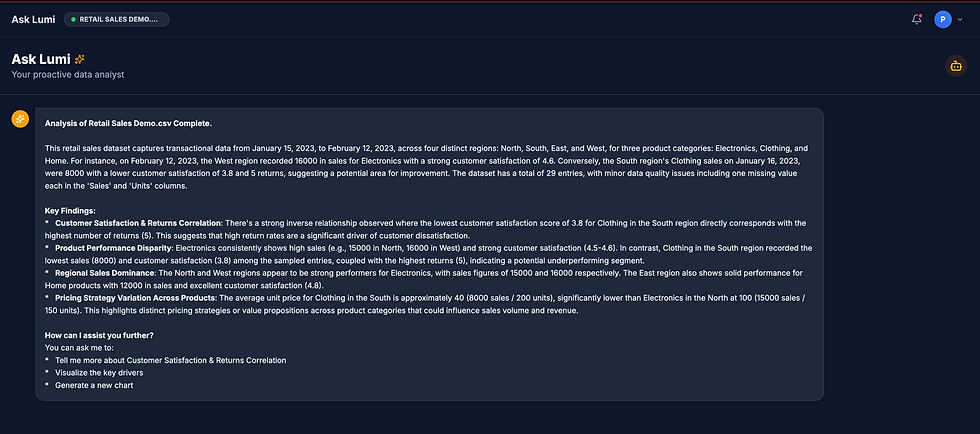
Dashboards and models still exist—but only as instruments of trust, not as the primary interface, generated automatically by the AI agent.

This framework represents a structural shift in how organizations consume intelligence and how future analytics platforms will operate.
If you’re new to Dialogue Intelligence You may want to start with The Future of Analytics Isn’t a Dashboard. It’s a Dialogue. – the philosophy behind this framework in plain language.
The Six Layers of the Dialogue Intelligence Framework (DIF)
Below is the full architecture — neutral, strategic, and at a level suitable for enterprise adoption, vendor comparison, and C-suite presentations.
1. The Question Layer (Q-Layer)
Intent Understanding, Cognitive Alignment, Conversational Context
The Q-Layer is the “front door” of a dialogue-native analytics system. It interprets business questions not as commands, but as expressions of intent.
Capabilities
Natural language interpretation
Intent extraction and business framing
Context tracking across interactions
User sophistication calibration
Domain-aware interpretation
Enterprise Value
Reduces the cognitive load on users. They no longer translate business questions into data instructions — the system does.
2. The Exploration Layer (X-Layer)
Autonomous Data Scanning, Hypothesis Generation, Continuous Discovery
The X-Layer functions as a perpetual analyst, continuously exploring the data environment whether or not a question is asked.

Capabilities
Autonomous pattern detection
Segmentation, anomaly, outlier analysis
Correlation and causality scanning
Hypothesis testing and counterfactuals
Insight ranking by relevance and impact
Enterprise Value
Insight is no longer a scheduled activity (weekly dashboards or quarterly reports).Insight becomes a continuous service.
3. The Insight Layer (I-Layer)
Narrative Construction, Decision Support, Action Orientation
The I-Layer transforms analytic findings into insight — structured, contextual, and actionable.
Capabilities
Narrative explanation generation
Driver and root-cause interpretation
Comparative, temporal, and geographic framing
Decision recommendations
Chart and visualization creation on-demand
Enterprise Value
Leaders receive meaning, not metrics.Insight becomes accessible to all levels of the organization.
4. The Trust Layer (T-Layer)
Transparency, Explainability, Data Quality Signaling
Trust is the limiting factor in AI-driven analytics.The T-Layer provides clarity and transparency necessary for adoption.
Capabilities
Explainable reasoning paths
Data provenance and lineage access
Confidence scoring and uncertainty quantification
Data quality indicators and anomaly flags
Governance and compliance alignment
Enterprise ValueAccelerates adoption, reduces risk, and builds confidence in AI-generated insight.
5. The Memory Layer (M-Layer)
Personalization, Learning from Feedback, Adaptive Intelligence
The M-Layer continuously learns from interactions with users, datasets, and business outcomes.
Capabilities
Recall of past questions and sessions
Learning what users deem “Helpful” vs. “Not Relevant”
Adaptive explanation style
Domain and vocabulary learning
Preference modeling by persona
Enterprise Value
The system matures into a tailored analytical partner — different for the CFO, COO, Marketing Director, or Store Manager.
6. The Foundation Layer (F-Layer)
Data Integration, Semantic Modeling, Structural Stability
The F-Layer provides the necessary substrate while minimizing operational burden.
Capabilities
Data ingestion and unification
Schema and metric understanding
Semantic entity modeling
Access control
Pipeline and structure integrity monitoring
Enterprise Value
A stable foundation that supports intelligence without requiring users to touch infrastructure.
Why DIF Represents a Structural Shift
DIF is not an incremental evolution in BI. It is a foundational redefinition.
Where traditional analytics is tool-first, DIF is insight-first.
Where traditional BI relies on users pulling insights, DIF pushes insight proactively.
Where agentic AI often automates existing tools, DIF replaces the workflow with a new interface: dialogue.
Where old systems depend on dashboards, DIF makes dashboards optional.
Where traditional analytics reacts to questions, DIF discovers insights autonomously.
Strategic Impact for Enterprises
Faster decision cycles
Proactive issue detection
Reduced analytics backlog
Lower dependency on dashboards
Higher adoption by business teams
Greater trust and transparency
More time spent on action, less on tool navigation
Strategic Impact for SMBs and Underserved Markets
Eliminates need for specialized data teams
Makes analytics accessible conversationally
Reduces cost and complexity barriers
Provides enterprise-grade intelligence to smaller organizations
Conclusion
The Dialogue Intelligence Framework represents the next frontier in analytics:
a shift from navigating dashboards and pipelines to engaging in meaningful dialogue with an intelligent system.

In this future:
Insight comes to the user
Questions become the interface
Systems think before users ask
Analytics becomes conversational, continuous, and cognitively aligned
DIF is not just a framework — it is a blueprint for the next decade of analytical transformation.
Read More ... Where DIF meets real-world scenarios?
• Revolutionizing Small Business Analytics with Local-First AI Solutions – what Dialogue Intelligence means for underserved SMBs.
Harnessing Predictive Maintenance Tools for Efficiency – how continuous insight applies to maintenance and operations.
Maximizing Potential with an AI Center of Excellence – how to structure an AI & analytics function to support DIF.


Comments